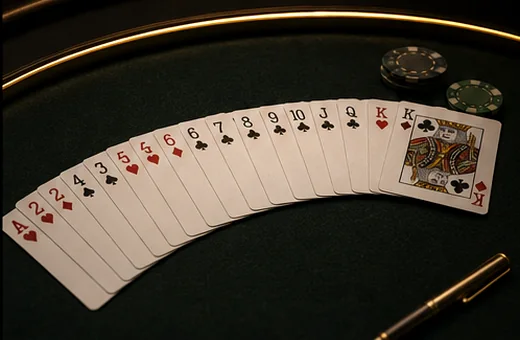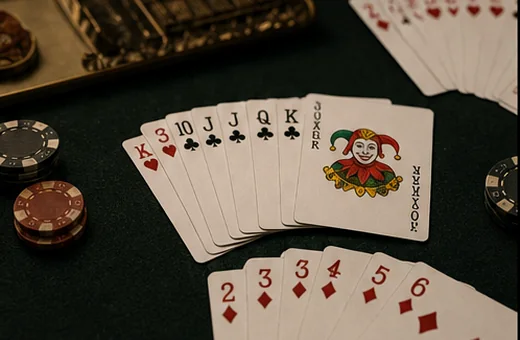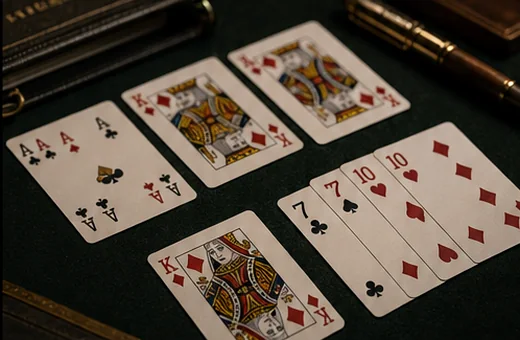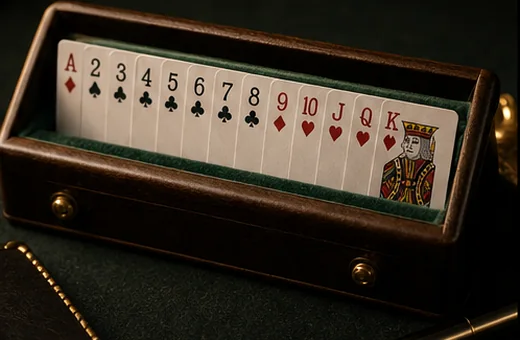
Grouping rule
Can one card be used in both a set and a sequence?
A valid declaration partitions the hand: each physical card belongs to one submitted group only.
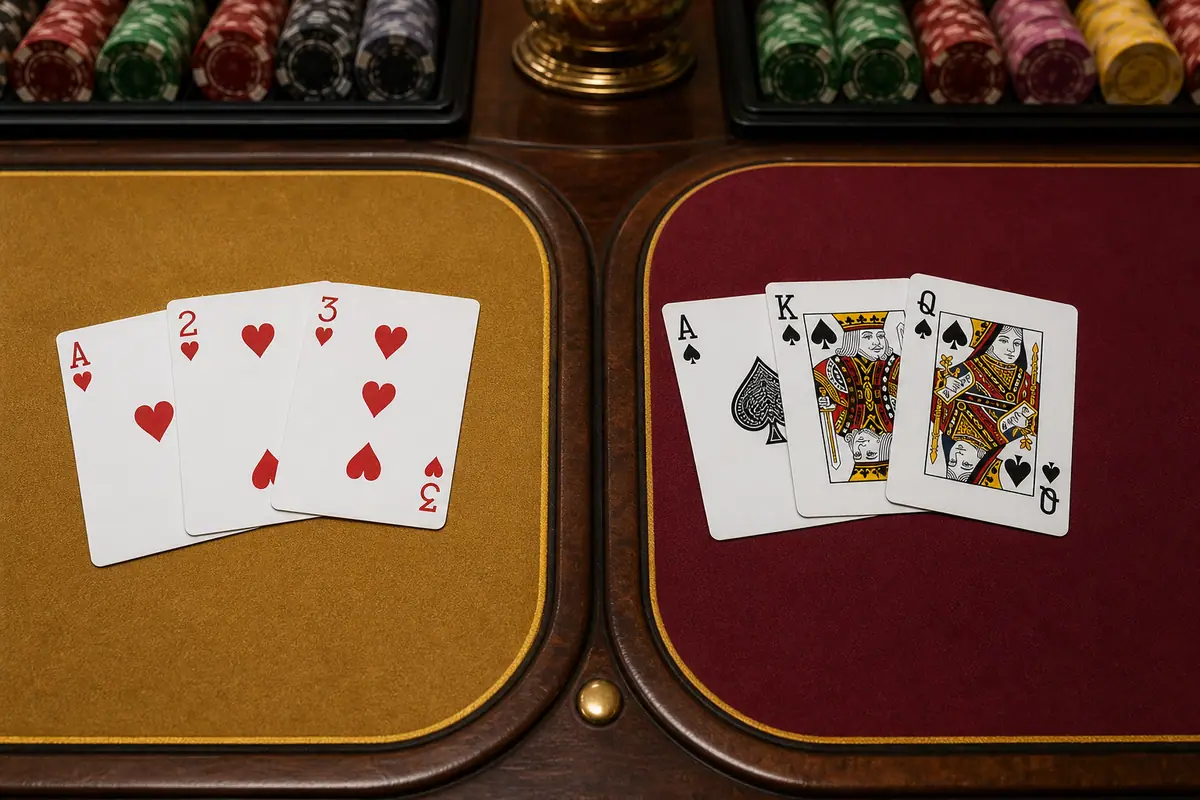
Direct answer: No. One physical card cannot be counted in both a set and a sequence in the same Indian Rummy declaration. For example, 7♥ cannot simultaneously complete 5♥-6♥-7♥ and the set 7♥-7♣-7♦. Choose one group for it, then find another real card to complete the other group.
Overlap example
| Proposed group | Problem | Correction |
|---|---|---|
| 5♥ 6♥ 7♥ | Uses the only 7♥ | Keep as the pure sequence |
| 7♥ 7♣ 7♦ | Reuses that same 7♥ | Add another legal seven, or regroup |
Why duplicate-looking cards can confuse
Multi-deck games can contain two physical copies of 7♥. If you genuinely hold both, each copy may go into a different group, subject to the app’s set rules. The important distinction is two real cards versus one card displayed twice in your plan.
Count once before declare
- Lay out every group separately.
- Touch or count each physical card once.
- Confirm the total is thirteen.
- Fix any group whose card total depends on an overlap.
Worked thirteen-card correction
Assume you hold 5♥-6♥-7♥, 7♣-7♦, 9♠-10♠-J♠, 2♣-3♣-4♣ and K♦-K♣. If the single 7♥ is also placed with 7♣-7♦, the display appears to have fourteen positions but only thirteen physical cards. Keep 7♥ in the pure run and draw another legal king or seven to complete a separate set.
Three overlap traps
| Trap | Why it is wrong |
|---|---|
| Same card shown in two groups | One physical card was counted twice |
| Joker assigned two different ranks | A single joker has only one group role |
| One duplicate card assumed without holding it | Multi-deck play permits copies, but the copy must exist in the hand |
How apps help and where to check
Many interfaces physically move a card from one group to another, preventing a true duplicate. Confusion can still arise when a drag preview leaves a ghost outline or when two deck copies have identical faces. Count the selectable cards, use any deck-copy marker, and wait for the final group preview to settle.
A wild-rank card is still one physical card. If 8s are wild and you hold 8♥, placing it as a substitute in an impure sequence means it cannot also remain in a set of eights. The special role changes how the card functions, not how many times it exists.
Final partition test
Write the group lengths, such as 3 + 3 + 3 + 4. If they total thirteen and every position points to a different physical card, the partition passes this specific test. You must still validate suit, rank order, set composition, pure sequence, and any house-specific duplicate rule.
Source and rule boundary
PlayRummy’s declaration rules require the dealt cards to be arranged into valid groups. This implies a partition of the actual hand, not reuse of one card. Apps may display duplicate deck copies with small identifiers.